Having the opportunity to spend time with a considerable amount of smart people, I’m always surprised how my high IQ friends have great speaking abilities, are highly proficient in problem solving, artistic and creative minds that never stop to amaze, so I often think to myself if there Is any consequence to these seemingly super human abilities, although my experience is totally subjective it has certainly inspired me to look into the downfalls of intelligence.
It turns out there are some bad news, a paper published by the journal of intelligence has found an association between high IQ and various mental and immunological diseases such as anxiety bipolar disorder ADHD depression, as well as allergies and immune disorders, the founding was done by Pitzer College researcher Ruth Karpinski and her colleagues who surveyed members of Mensa a high IQ society who are in the upper 2 % of top IQ that 132 or higher, in comparison to the general population being at 100.
The survey included a multiple anxiety and mood disorders, ADHD and autism. The authors of the study compared 3715 members. Results where[BR1] mind boggling as they showed that highly intelligent people are 20 % more likely to be diagnosed with autism 80% more likely to have ADHD, 182% more likely to have at least one mood disorder and 83 % more likely to have anxiety, these numbers are concerning but what comes next is even more staggering as the research further shoed that highly intelligent people are 84 % more likely to have an immune system disease, 108% more likely to have asthma and 213% more likely to have allergies
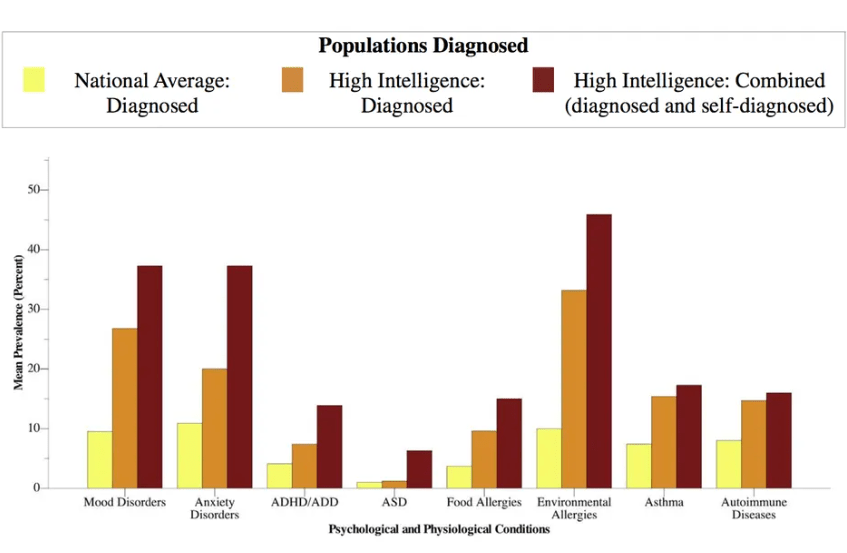
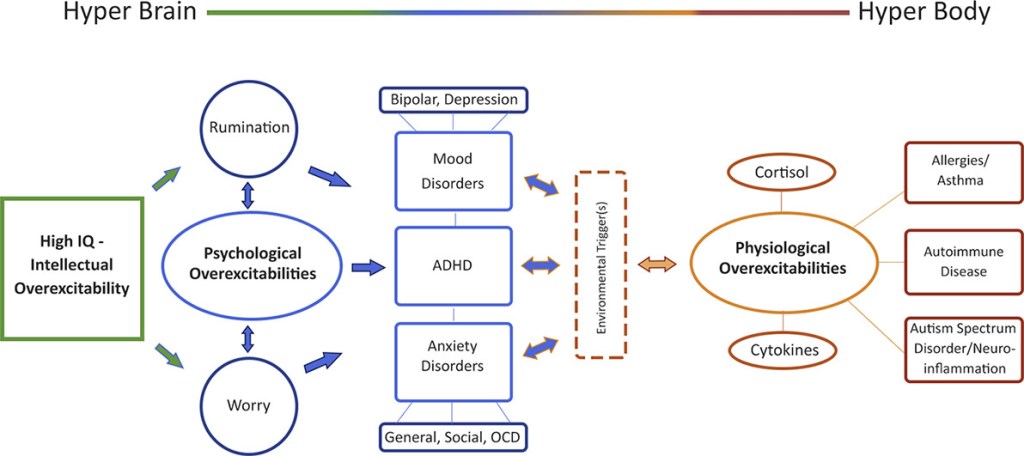
The researchers surprised by such differences turned into psychoneuroimmunology to find answers, PNI for short examines how accumulated chronic stress influences the brain and autoimmune systems. Karpinski and her colleagues propose the hyper brain/hyper body theory. This theory holds that, for all of its benefits, being highly intelligent is linked with psychological and physiological “overexcitabilities, this gives them heightened awareness that could hep with creativity, but it can however lead to depression and poor mental health.
A very clever person may compulsively overanalyse a critical situation from his girlfriend, trying to foresee all the potential outcomes it may predict. Though this is an advantage when used to plan complicated tasks or master something , the same power can be used for negative thoughts that cause anxiety and the psychological effects can be catastrophic.
Psychological Overexcitabilities derives from higher tendencies to overthink and worry
Whereas physiological overexcitabilities derive from the body’s response to anxiety and stress that produce cortisol and cytokines therefore contributing to a variety of autoimmune issues
There may be many different explanations for this phenomenon in addition to the overexcitability hypothesis, and they may all be relevant to some degree. One possibility is that the genes associated with intelligence also make you more prone to mental illness, but intelligence does not directly increase your risk of mental illness. Another possibility is that people with higher IQs are often more socially isolated, which leads to more anxiety and depression. For example, people with autism spectrum disorders and above-average IQ are at much higher risk for depression. That may also happen to a lesser extent with intelligent people not on the spectrum.
It can be argued that the study done by Karpinski is to be taken cautiously since its correlational, as it’s possible that members of Mensa are in some way different not just in IQ but some other trait as well. But its to take in account that if this study provides to pe applicable to the general population then intervention can be made accordingly to help people avoid illness and live happier lives.
It seems like that Intelligent people make mistakes just like all of us, but those mistakes can be harder on them as they know they should do better or live up to a certain expectation this can create a burden. This is evidences by a survey done in 1926 by psychologist Lewis Terman. Surveying over 1500 intellectually gifted kids through their lives, the result of the studies showed that intelligence had no real direct influence on their live achievement. As all rates suicide, alcoholism success where the same as the rest of society, furthermore some participants complained that there lives where burdened by the knowledge that they must live up to their promising intellects.
Another downfall is that intelligence doesn’t necessary correlate to better decision making or being more openminded as Dr. Keith Stanovich suggests that people ho are more intelligent are fund to be no more likely to be unbiased or better at rationalizing while being more prone to rational bias blind spots, this makes the less likely to see their own flaws and more likely to see others, this can be a considered to be major lack on insight and hold back intelligent people in the achievement of success or catching opportunities this inability to rationalize ones own actions and having a biased prospective is often referred to as Dysrationalia.
The problem of inability of connection is as viscous as it sounds, as highly intelligent people find it difficult to fit in, this an effect of different interests between themselves and peers or even fear of failure which can manifest into crippling perfectionism and inability to even start.
To conclude there are widespread arguments on the nature of the links between intelligence mental health, physical health and success, this is made more difficult by the fact that measuring intelligence its in it self a hard task as psychologist today ague that intelligence takes many forms many of which are not possible to detect in a IQ test, as for example creative intelligence musical intelligence. And many also argue that mental health issues are a contributing factor for some kinds of intelligence.
Having a high IQ or being Intellectually gifted in any area can be both a blessing and a curse as on its own intelligence doesn’t guarantee anything but as evidence shows (Karpinski 2018) only mental and physical disorders, this shows how even the most powerful minds have their down falls, so look after each other and font discriminate based on Intelligence. As it seems like we all have the same issues.
References List:
Cravens, H. (1992). A scientific project locked in time: The Terman Genetic Studies of Genius, 1920s–1950s. American Psychologist, 47(2), 183.
Karpinski, R. I., Kolb, A. M. K., Tetreault, N. A., & Borowski, T. B. (2018). High intelligence: A risk factor for psychological and physiological overexcitabilities. Intelligence, 66, 8-23.
Stanovich, K. E. (1993). Does reading make you smarter? Literacy and the development of verbal intelligence. In Advances in child development and behaviour (Vol. 24, pp. 133-180). JAI.
Stanovich, K. E., West, R. F., & Toplak, M. E. (2011). Intelligence and rationality.
Stanovich, K. E., & Stanovich, P. J. (2010). A framework for critical thinking, rational thinking, and intelligence.
Terman, L. M. (1981). Mental and physical traits of a thousand gifted children (Vol. 1). Stanford University Press.
Terman, L. M. (1931). The gifted child.
Vialle, W. (1994). “Termanal” science? The work of Lewis Terman revisited. Roeper Review, 17(1), 32-38.
 The Wrong Side of Time
Hey, I found this interesting, but it means that all intelligent people are actually suffering because of their intelligence, that’s sad.
LikeLike
Thanks, Kay for your comment, I feel like you are mentioning the Mensa study, while it can seem like all highly intellectual people are inevitably going to be depressed, the study it’s done only on a particular demographic being Mensa participants, it can be also argued that they might have further differences from the general population rather than only IQ, researchers have argued that Mensa members might be less physically active than the general population and that might be one of the contributing factors to their psychological and physical issues. Furthermore being such a defined class of individuals it’s still unclear how the results from the study apply to the general population, but I don’t think that all intelligent people are doomed!
LikeLike
I can totally relate to the stress and autoimmune issue every time I’m feeling depressed also my stomach doesn’t function well, it become a viscous circle.
LikeLike
Stress has multiple effects both psychological and physical, I would suggest you, take the advice of your doctor and seek help as soon as possible, do not fear of not being comprehended, the best thing you could do to fight depression is to seek the help of a professional, you don’t have to be alone in this
LikeLike
Okay so basically if you are gifted you are doomed in a way, and if you are taking cortisol from a doctor does that make you more depressed?
LikeLike
Cortisol does have an effect on your psyche as its a stress hormone and corticosteroid can also suppress the effectiveness of the immune system and Stress can also have an indirect effect on the immune system as a person may use unhealthy behavioural coping strategies to reduce their stress, such as drinking and smoking. But obviously, consult your doctor before acting in any way on the intake of cortisol.
LikeLike
Is intelligence innate or acquired??
LikeLike
Hi Judy,
Thanks for having read my blog.
Some evidence indicates that Intelligence seems to be inherent. You are born with a genetical predisposition that is passed to you from your parents as its indicated by the Plomin & Spinath, 2004 fraternal twin study that showed how identical twins IQ’s are more similar than those of fraternal twins. The argument for genetical influence is furthered by McGue & others, 1993 study that demonstrated that siblings raised together in the same home have IQ’s that are more similar than those of adopted children raised together.
That said Intelligence has also been shown as being learned as environmental situations play a big role in a persons intelligence factors like the way a child is raised attention schooling wealth and society. supporting evidence being study by (McGue & others, 1993 on identical twins reared apart, showed to have IQ’s that are less similar than identical twins reared in the same environment, another interesting supporting study for the case is Kramer & others, 2008 study that showed Children who are breastfed during the first three to five months of life score higher on IQ tests at age 6 than same-age children who were not breastfed.
The evidence can seem to be of opposing view but it can be argued that intelligence is influenced by both genetic and environmental factors, but the debate is still open on what is the major factor and how the influence functions.
I hope this clarifies the debate and gives you a better idea of the source of intelligence.
LikeLike